
UAE Corporate Tax Penalties 2026: Late Registration and Late Filing Fines for Dubai and Free Zone Businesses
UAE Corporate Tax Penalties 2026: Late Registration and Late Filing Fines Explained can be summarised simply: missing a Federal Tax Authority registration deadline can trigger an AED 10,000 administrative penalty, and missing a corporate tax return deadline can create monthly late filing penalties, plus exposure to late payment charges if tax is unpaid.
The safest position for 2026 is not to wait for reminders. Confirm whether your company, free zone entity, branch, or qualifying natural person must register, keep EmaraTax access active, and prepare the return well before the nine month filing window closes. This guide gives business owners a practical view of penalties, examples, and prevention steps, based on UAE Federal Tax Authority guidance available and checked on 15 July 2026.
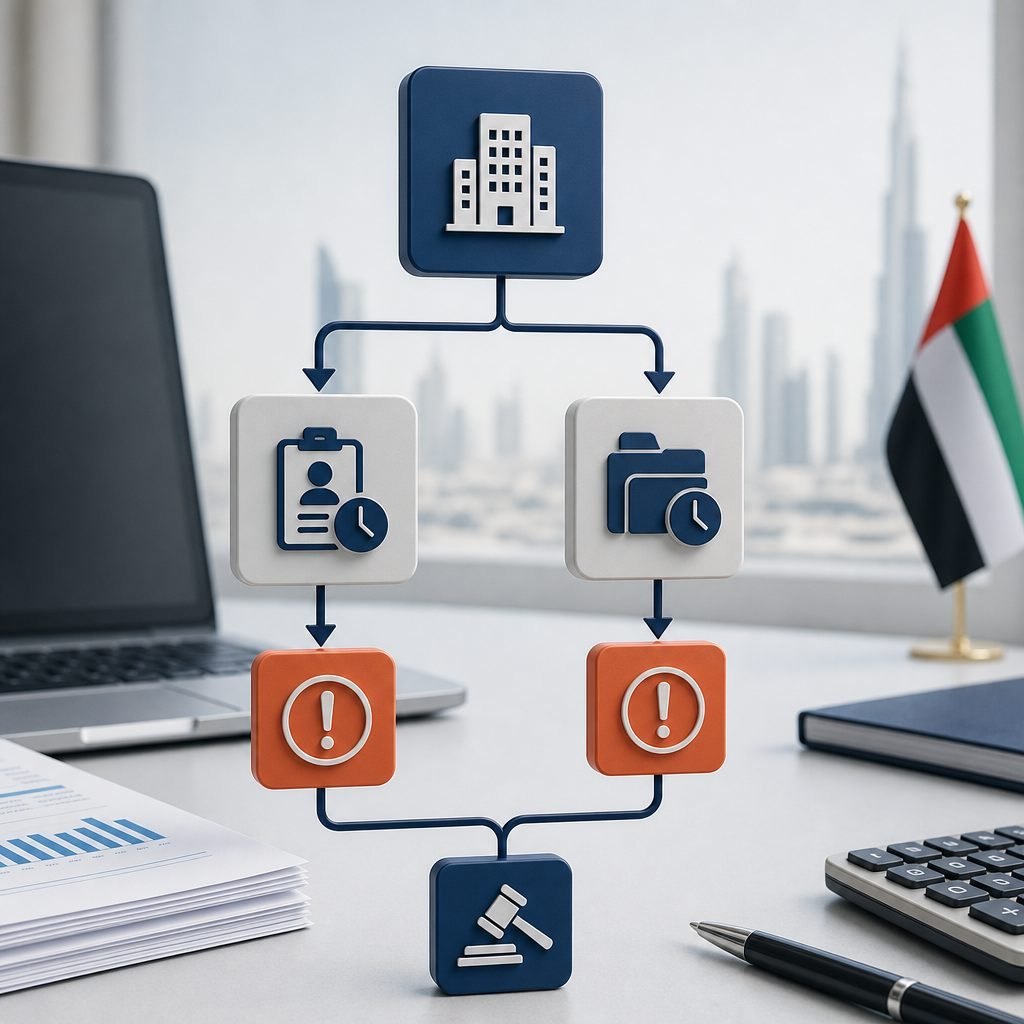
02 Understanding the FTA penalty framework in 2026
The UAE corporate tax regime is administered by the UAE Federal Tax Authority, commonly called the FTA. Registration, returns, correspondence, payment references, and many amendment requests are handled through EmaraTax. Penalties are administrative consequences for not meeting obligations under the Corporate Tax Law, the Tax Procedures Law, and related Cabinet and FTA decisions.
For directors and finance teams, the important point is that penalties are not limited to profitable businesses. A company with no tax payable can still be penalised if it registers late, files late, ignores information requests, or fails to keep records. Free zone businesses also need to treat compliance seriously, even when they expect a zero percent rate on qualifying income.
Important: This article is a practical overview, not a substitute for advice. Penalty rules can be amended, and the FTA may issue clarifications. Always check the latest EmaraTax notifications and official FTA publications before making a decision.
03 Late registration fine for corporate tax
As checked on 15 July 2026, the standard administrative penalty for failing to submit a corporate tax registration application within the prescribed timeframe is AED 10,000. This applies when a taxable person misses the applicable FTA registration deadline. It is separate from any tax liability and can arise before the first corporate tax return is due.
Registration deadlines are not identical for every taxpayer. Existing resident juridical persons were given deadlines linked to the month of licence issuance. New entities generally have shorter periods after incorporation or recognition. Non-resident persons and natural persons have separate triggers. Because of this, two businesses incorporated in the same year may have different deadlines.
Who is most at risk of late registration?
- Businesses that assumed corporate tax applies only after profit exceeds AED 375,000.
- Free zone companies that expected exemption and delayed registration.
- Groups with dormant, holding, or special purpose entities.
- Foreign companies with UAE permanent establishment exposure.
- Owner managed businesses where the licence renewal team and finance team do not coordinate.
A common misconception is that registration is the same as filing. They are separate obligations. You may need to register first, obtain a tax registration number, then file a return later for the relevant tax period.
04 Late filing fines and payment exposure
Corporate tax returns are generally due within nine months from the end of the relevant tax period. If a company with a 31 December year end has a tax period ending 31 December 2025, its return and payment would normally be due by 30 September 2026. Missing that date can create late filing penalties.
Under the administrative penalty framework, failure to submit a required tax return within the specified timeframe may lead to a monthly penalty, typically AED 500 for each month, or part month, for the first twelve months, increasing to AED 1,000 for each month, or part month, from the thirteenth month.
Late filing is different from late payment. If tax is due and remains unpaid, separate late payment charges may also apply. Therefore, a business can face three layers of cost: the original tax, a filing penalty, and payment related charges.
05 UAE Corporate Tax Penalties 2026: Late Registration and Late Filing Fines Explained with examples
Example one: a mainland LLC incorporated before corporate tax but overlooked its FTA registration deadline because the owner believed the accountant would handle it after year end. Even if the company has low profit and no tax payable, the late registration penalty can still be AED 10,000.
Example two: a free zone entity registered on time but did not prepare accounts early. Its audited financial statements were delayed, so the corporate tax return was filed two months after the deadline. The business may face late filing penalties for each month or part month of delay, even if its qualifying income is taxed at zero percent.
Example three: a consultancy owner asks how to register for corporate tax in UAE after receiving an EmaraTax reminder. The answer depends on legal form, licence date, and whether the person is a company or a natural person. Acting immediately may reduce further exposure, but it does not automatically remove an already triggered penalty.
Note: If you believe a penalty was applied incorrectly, review the EmaraTax notice, registration evidence, and deadline category before responding. Do not ignore the notice while investigating.
06 How to prevent penalties before they happen
Penalty prevention is mainly a process issue. Senior management should not rely on one person’s memory or on annual audit timing. Build a simple tax compliance calendar, assign ownership, and review EmaraTax regularly.
Practical checklist
- Map every UAE licence, branch, free zone entity, and dormant company.
- Confirm the registration deadline and keep proof of the assessment.
- Maintain active EmaraTax login credentials and authorised users.
- Prepare accounting records monthly, not only at year end. Our checklist of the accounting records required for corporate tax sets out what the FTA can ask to see and how long each document must be kept.
- Reconcile related party balances, owner withdrawals, and tax adjustments early.
- Set reminders at least sixty, thirty, and ten days before filing.
- Document nil activity, exemptions, and free zone positions with supporting evidence.
Businesses that would rather hand the whole cycle over can review our corporate tax services in Dubai and the UAE, which cover registration, computation and filing under one engagement. For teams researching how to register corporate tax in UAE, remember that the application is only one part of the control environment. After registration, the business still needs clean bookkeeping, supporting schedules, transfer pricing documentation where relevant, and management approval before filing.
07 Common mistakes that create avoidable fines
Most penalty cases begin with ordinary operational gaps. The business may change accountants, open a new branch, pause trading, or renew a licence without telling finance. Corporate tax deadlines then fall between departments.
Mistakes to avoid
- Assuming no profit means no registration or return obligation.
- Waiting for audited accounts before starting tax computations.
- Using an old email address for FTA and EmaraTax notices.
- Treating free zone status as automatic relief from compliance.
- Confusing VAT tax registration numbers with corporate tax registration.
- Failing to update authorised signatories after ownership or manager changes.
A useful management question is: if the finance manager is unavailable, can another authorised person access EmaraTax, see deadlines, and submit evidence? If the answer is no, the company has a continuity risk, not just a tax risk.
08 What to do if you are already late
If you have missed a deadline, speed and documentation matter. First, identify the obligation missed: registration, return filing, tax payment, deregistration, or information submission. Second, complete the outstanding action through EmaraTax as soon as possible. Third, download the submission acknowledgement and penalty notice.
Next, assess whether the deadline category was correctly applied. For example, check licence issue dates, tax period dates, natural person turnover triggers, and non-resident presence. If a factual error exists, prepare a clear explanation with evidence before contacting the FTA or seeking reconsideration.
Do not file a rushed return with unreliable figures just to stop penalties. Incorrect returns can create amendment work, audit exposure, and management reporting issues. If records are incomplete, prioritise bank reconciliations, revenue cut off, deductible expense support, related party schedules, and tax payment planning.
09 Business implications beyond the fine
The financial cost of an AED 10,000 registration penalty or monthly filing penalties is only part of the issue. Late compliance can delay bank financing, investor due diligence, licence transactions, group restructuring, and exit planning. It can also damage confidence between owners and finance teams.
For free zone businesses, late filing may be especially disruptive because qualifying status often depends on maintaining substance, records, audited statements, and correct income classification. A penalty notice may prompt wider review of whether the business can support its tax position.
For groups, one missed entity can affect consolidated reporting, intercompany recharge calculations, and board certifications. That is why corporate tax compliance should sit alongside governance, accounting, and risk management, not at the end of a checklist.
10 FAQs and next step
Can the FTA waive corporate tax penalties?
Penalty waivers or reconsideration depend on the facts, evidence, and applicable procedures. Businesses should not assume relief is automatic. If you receive a notice, respond within the required process and keep proof of all submissions.
Does a dormant company need to register for corporate tax UAE?
Often, yes, if it is a taxable person within the registration rules. Dormant status does not remove obligations by itself. Check the legal form, licence, and FTA deadline category before assuming no action is required.
How early should we prepare the return?
Start before the period ends where possible, then finalise after accounts are closed. Leaving computations until the ninth month is risky, especially where audits, related party transactions, or free zone income analysis are involved.
In short: register on time to avoid the AED 10,000 late registration penalty, and file within nine months of your period end to avoid monthly late filing penalties. If your financial year ended on 31 December 2025, your deadline is 30 September 2026 — use our 30 September 2026 corporate tax filing checklist.
Protect your business before penalties escalate
If you want certainty, speak with STH Financial. Our corporate tax advisers can review your registration status, EmaraTax access, filing, and penalty exposure. Start with our corporate tax advisory services.