As the 2025 UAE Corporate Tax filing deadline approaches, many business owners are asking:
“Can I do my own corporate tax return?”
While the EmaraTax portal is designed to be accessible, the real question isn’t whether you can file yourself, but whether you can afford to be wrong. In the UAE’s evolving tax environment, even minor inaccuracies can trigger significant penalties.
This guide explores the feasibility of DIY filing and explains why incorrect information has become one of the most expensive mistakes a UAE business can make.
Is It Legally Possible to File Yourself?
Yes.
The Federal Tax Authority (FTA) allows a Taxable Person—or an authorised representative—to submit the Corporate Tax return directly through the EmaraTax portal.
However, Corporate Tax is not a simple summary of accounts.
It requires converting Accounting Profit into Taxable Profit, which involves multiple legal and technical adjustments, including:
Identifying non-deductible expenses (such as fines, penalties, and restricted entertainment costs).
Correctly applying Small Business Relief (subject to conditions) where revenue does not exceed AED 3 million.
Ensuring compliance with the arm’s length principle for Related Party and Connected Person transactions.
These areas require interpretation of tax law, not just simple data entry.
The High Price of “Wrong Information”
Under the UAE Tax Procedures Law, the responsibility for the accuracy of the Corporate Tax return lies entirely with the taxpayer—even when errors are unintentional.
1. Penalties for Inaccurate Filing
Submitting an incorrect Corporate Tax return may result in a fixed administrative penalty of AED 500 per violation.
Where inaccuracies lead to unpaid tax, penalties can reach up to 200% of the tax difference in serious cases, depending on the nature and severity of the non-compliance.
2. The AED 10,000 Registration Trap
Before filing, businesses must be registered for Corporate Tax.
Failure to register by the applicable deadline—determined by the trade license issuance month—results in an automatic AED 10,000 penalty, with no discretionary waiver mechanism.
3. Record-Keeping Violations
Filing the return is only part of the compliance obligation. Businesses are legally required to retain supporting documentation (including invoices, ledgers, contracts, and bank statements) for seven years.
Failure to produce these records during an FTA audit may result in penalties ranging from AED 10,000 to AED 20,000 per violation.
Why Most SMEs Choose Professional Review
While filing independently may appear to save professional fees, a single interpretation error can cost far more than the filing itself.
Businesses engage firms like STH Financial Services for:
Audit-ready returns with defensible tax adjustments.
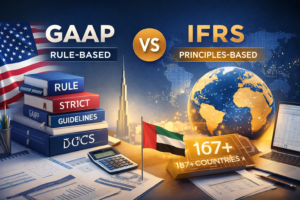
IFRS-compliant financial statements, as required by the FTA.
Proper evaluation of Small Business Relief, grouping, and elections.
Reduced risk of audits, penalties, and future disputes.
Conclusion: Accuracy Is the Real Investment
Yes, you can file your own Corporate Tax return.
But in the UAE’s compliance-focused tax environment, you cannot afford to be incorrect. Do-it-yourself filings often lead to audit flags, penalty notices, and avoidable compliance issues that can affect banking relationships and investor confidence.
Don’t let a clerical or interpretation error turn into a five-figure penalty.
Book a Corporate Tax Review with STH Financial Services today to ensure your 2025 Corporate Tax filing is accurate, compliant, and stress-free.