1. Introduction
If you are running a business in the UAE, you have probably heard both “GAAP” and “IFRS” mentioned when discussing accounting and financial reporting. But what exactly do these terms mean for your company, and which standard actually applies to your UAE business?
Here is the surprising truth: The UAE does not have its own separate “UAE GAAP.” Instead, the UAE follows International Financial Reporting Standards (IFRS) as its primary accounting framework. However, the specific requirements vary depending on your company type, size, and industry.
This guide cuts through the confusion and explains exactly which accounting standards apply to different types of UAE companies in 2026. Whether you are a startup in a free zone, an established mainland company, or a publicly listed corporation, you will find clear answers here.
2. Quick Answer: Which Standard Applies to My UAE Company?
| Your Company Type | Required Standard |
|---|---|
| Publicly listed company | Full IFRS |
| Bank or financial institution | Full IFRS (mandatory since 2008) |
| Large private company | Full IFRS recommended |
| Small/medium company (SME) | IFRS for SMEs OR Full IFRS |
| Free zone company | Depends on zone and activities |
| ** Sole establishment** | Simplified standards acceptable |
Key Point: The UAE does not have a separate “UAE GAAP.” All companies use some form of IFRS—either full IFRS, IFRS for SMEs, or a modified version.
3. Understanding GAAP vs IFRS: The Basics
What is GAAP?
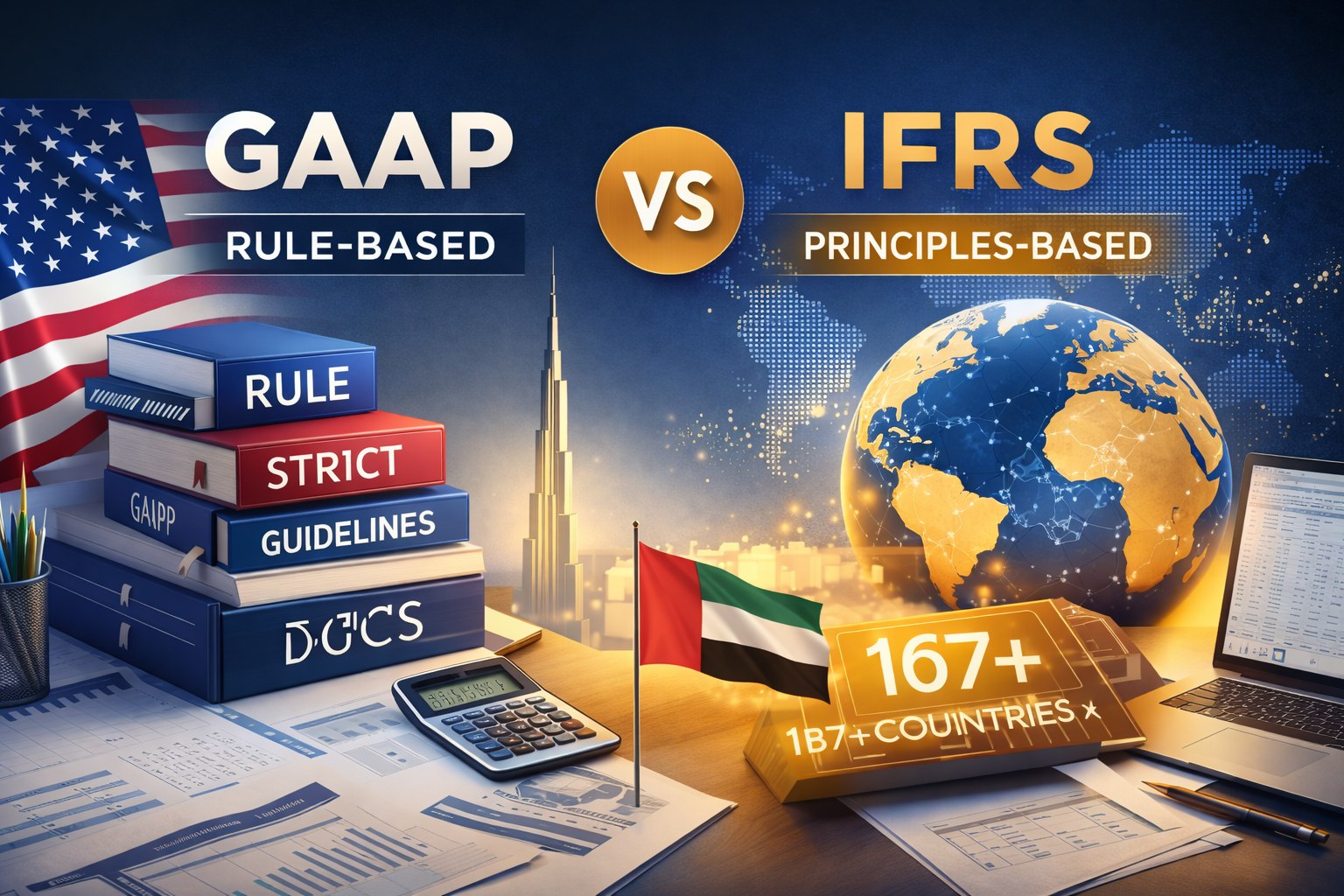
GAAP (Generally Accepted Accounting Principles) refers to accounting standards used primarily in the United States. GAAP is rules-based, meaning it provides specific guidelines for virtually every accounting scenario. This approach offers detailed instructions but can be less flexible when dealing with unique business situations.
What is IFRS?
IFRS (International Financial Reporting Standards) is used in over 167 countries worldwide, including the UAE. IFRS is principles-based, focusing on the economic substance of transactions rather than strict rules. This flexibility allows companies to present their financial position more accurately based on specific circumstances.
Key Differences at a Glance
| Aspect | GAAP | IFRS |
|---|---|---|
| Approach | Rules-based | Principles-based |
| Used In | United States | 167+ countries |
| UAE Status | Not officially adopted | Primary standard |
| Inventory Methods | LIFO allowed | LIFO prohibited |
| Asset Revaluation | Cost only | Revaluation allowed |
| Development Costs | Usually expensed | May be capitalized |
4. What UAE Companies Actually Use
Full IFRS Requirements
The following UAE companies must use full IFRS:
- Publicly listed companies on Dubai Financial Market or Abu Dhabi Securities Exchange
- Banks and financial institutions (mandatory since 2008)
- Insurance and reinsurance companies
- Large corporations with significant public accountability
- Companies preparing for IPO or international expansion
Full IFRS requires comprehensive financial statements including statement of financial position, statement of profit or loss, statement of changes in equity, cash flow statement, and notes to accounts.
IFRS for SMEs
Small and medium-sized enterprises in the UAE can use IFRS for Simplified Requirements, which offers:
- Reduced disclosure requirements
- Simplified recognition and measurement rules
- Less frequent revaluation requirements
- Streamlined financial statement formats
Eligibility for IFRS for SMEs typically includes:
- Not publicly accountable
- Publishing general purpose financial statements
- Having no public accountability for stakeholder funds
UAE Corporate Tax Connection
Important: UAE corporate tax compliance requires financial statements prepared using IFRS or IFRS for SMEs. The Federal Tax Authority (FTA) specifically requires this standard for corporate tax filing purposes. Companies using cash-basis accounting or spreadsheets may face compliance issues.
5. Common Questions About UAE Accounting Standards
Does the UAE have its own GAAP?
No. Unlike countries with established national accounting frameworks, the UAE does not maintain a separate “UAE GAAP.” The UAE has adopted IFRS as its primary financial reporting framework since 2014, with specific requirements for different entity types.
Can my company choose between GAAP and IFRS?
No. UAE companies must use IFRS. However, they can choose between full IFRS and IFRS for SMEs based on their size and complexity. US GAAP is not officially permitted for UAE companies.
What about free zone-specific requirements?
Some free zones may have additional reporting requirements, but all ultimately require IFRS-compliant financial statements. Free zone companies should verify specific requirements with their respective zone authority.
Are there new IFRS standards in 2025/2026?
Yes. IFRS 18 (Presentation and Disclosure in Financial Statements) is the major new standard becoming effective. Companies should prepare for implementation and update their financial reporting processes accordingly.
6. IFRS vs GAAP: Which Should Your UAE Company Choose?
If your company has a choice between full IFRS and IFRS for SMEs, consider these factors:
| Factor | Choose Full IFRS | Choose IFRS for SMEs |
|---|---|---|
| Company Size | Large, complex operations | Smaller, simpler structure |
| Public Accountability | Listed or regulated | Private company |
| Stakeholder Needs | Complex reporting needs | Basic financial information |
| International Investors | Seeking global investors | Local operations only |
| Compliance Cost | Higher (more requirements) | Lower (simplified) |
Bottom Line: If you are unsure which applies to your UAE company, consult with a qualified accountant or auditor who understands UAE regulatory requirements.
7. Special Offer: Free IFRS Assessment for UAE Companies
Limited Time Offer — Until 28th February 2026
FREE IFRS Readiness Assessment for new clients!
This comprehensive assessment includes:
- ✅ Current accounting standards evaluation
- ✅ IFRS vs IFRS for SMEs eligibility check
- ✅ Corporate tax compliance review
- ✅ Financial statement gap analysis
- ✅ Action plan for full compliance
Ensure your UAE company meets all 2026 accounting standards!
8. Ready to Get Compliant?
Understanding GAAP vs IFRS and determining which standard applies to your UAE company is essential for legal compliance and business success. With UAE corporate tax now in effect and increasing regulatory scrutiny, having the right accounting foundation matters more than ever.
Whether you need full IFRS implementation, IFRS for SMEs guidance, or simply want to verify your current compliance status, professional support can save you time, money, and potential penalties.
Take the confusion out of UAE accounting standards today!
Contact STH Financial Services
Need help determining which accounting standard applies to your UAE company?
📞 Phone: +971 52 629 1147
📧 Email: support@sthfinancial.com
📍 Location: Block C, VL-05-041, Main Building, SRTI Park, Sharjah, UAE