Navigating the UAE’s corporate tax landscape is a critical part of business operations in 2025. Since its implementation, Corporate Tax (CT) has evolved into a mandatory obligation. Understanding the nuances—especially the difference between Registration and Filing—is vital to avoid the heavy penalties recently introduced by the Federal Tax Authority (FTA).
This guide provides the exact steps for filing through the EmaraTax portal for the 2025 tax year, ensuring your business stays compliant and penalty-free.
Before You Begin: The Preparation Phase 🧐
Proper preparation is the key to a smooth filing process. For 2025, the FTA has placed higher emphasis on audited records for specific categories:
- Financial Audit Check: If your annual revenue exceeds AED 50 million, or if you are a Qualifying Free Zone Person, you are required to have audited financial statements.
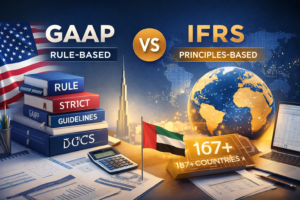
- Accounting Standards: Records must be prepared according to IFRS (International Financial Reporting Standards).
- Small Business Relief (SBR): If your revenue is AED 3 million or less, you may be eligible to elect for “Small Business Relief,” treating your taxable income as 0% for that period.
Step 1: Corporate Tax Registration & TRN 📝
A major misconception is that only “profitable” companies need to register. In reality, registration is mandatory regardless of profit levels if you meet the following:
- Juridical Persons: All UAE-incorporated entities (LLCs, PJSCs, etc.) and Free Zone entities must register.
- Natural Persons (Individuals): Freelancers and sole proprietors must register if their total revenue from business activities exceeds AED 1 million within a calendar year.
- The AED 10,000 Penalty: As of 2025, failing to register for Corporate Tax within the FTA’s specified timelines results in a fixed AED 10,000 penalty.
Step 2: Prepare the “Taxable Income” Calculation 📊
You do not simply file your “Net Profit.” You must calculate Taxable Income by making specific adjustments to your accounting profit:
- Non-Deductible Expenses: Add back 50% of entertainment expenses, certain fines/penalties, and donations to non-approved charities.
- Exempt Income: Deduct income that is not taxable, such as dividends received from other UAE companies.
- Transfer Pricing: Ensure transactions with “Related Parties” are at “Arm’s Length” (fair market value).
Step 3: The Filing Process via the EmaraTax Portal 💻
Crucial Correction: Corporate Tax filing is not done under the VAT tab. It has its own dedicated section.
- Log In: Access the EmaraTax portal using your UAE Pass or registered credentials.
- Dashboard Navigation: Look for the “Corporate Tax” tile on your main dashboard. Do not navigate to the VAT section.
- Initiate Return: Click on “View” under Corporate Tax, select your TRN, and click “File Return.”
- Complete Form CT01: Fill in the Accounting Schedule, Adjustments for Exempt Income, and any applicable Reliefs (like Small Business Relief).
- Review and Submit: The system will auto-calculate the tax due (9% on the amount exceeding AED 375,000).
- Payment: Use MagnatiPay or GIBAN transfer. Note that eDirham is no longer accepted.
Key Deadlines & Rates for 2025 ⏰
| Action | Deadline |
|---|---|
| Tax Filing & Payment | Within 9 months from the end of your financial year. |
| Example (Dec 31 Year End) | Deadline is September 30, 2025. |
| Tax Rate (0%) | Applies to taxable income up to AED 375,000. |
| Tax Rate (9%) | Applies to taxable income above AED 375,000. |
Common Mistakes to Avoid ❌
- The “VAT Section” Error: Many users look for CT forms under the VAT menu. They are separate tiles on the dashboard.
- Ignoring Nil Returns: Even if your company made zero profit, you must file a return.
- Missing Registration Deadlines: The AED 10,000 fine for late registration is strictly enforced in 2025.
Frequently Asked Questions (FAQ) 🤔
Q1: Is it mandatory to file even if I qualify for Small Business Relief?
A: Yes. You must still file a return and explicitly “elect” for Small Business Relief within the portal to benefit from the 0% rate.
Q2: What is the penalty for late filing?
A: Late filing results in a penalty of AED 500 per month for the first year, increasing to AED 1,000 per month thereafter.
Q3: Do Free Zone companies have to pay Corporate Tax?
A: They must register and file. They may qualify for a 0% rate on “Qualifying Income,” but non-qualifying income is taxed at 9%.
Need Expert Help with Your Corporate Tax Filing? 🤝
At STH Financial Services, we specialize in providing seamless, accurate, and transparent Corporate Tax services. Let our team handle your compliance so you can focus on growing your business.
📞 Call / WhatsApp: +971 52 629 1147
🌐 Visit: www.sthfinancial.com