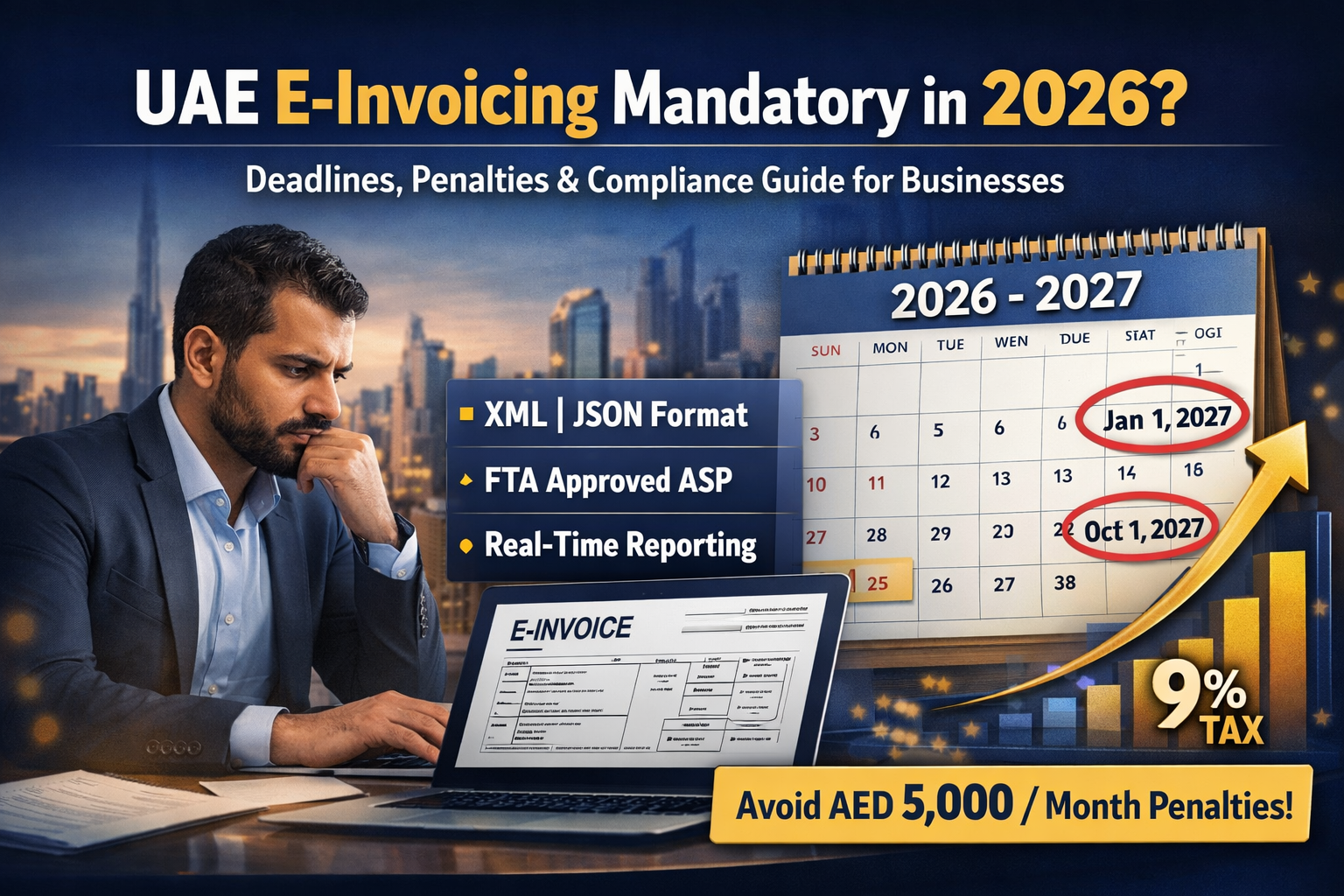
If you issue invoices in the UAE, you need to pay attention to what’s happening in 2026 and 2027.
The UAE government has officially rolled out its mandatory e-invoicing system, with deadlines fast approaching. Missing these dates could cost your business thousands of dirhams in penalties.
The question every UAE business owner is asking:
“Is e-invoicing mandatory for my business, and when do I need to comply?”
The answer depends on your annual revenue—but regardless of size, nearly every UAE business will eventually need to switch from paper and PDF invoices to electronic, structured formats.
In this comprehensive guide, we’ll break down exactly who must comply, the critical deadlines, penalties for non-compliance, and the step-by-step actions you need to take right now.
What Is E-Invoicing in the UAE?
Definition
E-invoicing (electronic invoicing) is the digital creation, exchange, and processing of invoices between buyers and sellers in a structured, machine-readable format.
Key Requirements:
- Invoice must be in XML or JSON format (not PDF or scanned documents)
- Must be transmitted through an Accredited Service Provider (ASP)
- Must be reported to the Federal Tax Authority (FTA) in real-time
- Must meet all UAE VAT invoice requirements
What’s Changing?
Before e-invoicing:
- Create PDF or paper invoices manually
- Send via email or WhatsApp
- Store records in folders or basic software
After e-invoicing:
- Generate invoices through FTA-approved software
- Transmit automatically to FTA via ASP
- Real-time reporting and validation
- Digital audit trail for every transaction
Who Must Comply? (By Business Size)
Phase 1: Large Businesses (AED 50 Million+ Revenue)
| Category | Details |
|---|---|
| Revenue Threshold | Annual taxable supplies ≥ AED 50 million |
| ASP Appointment Deadline | July 31, 2026 |
| Go-Live Date | January 1, 2027 |
| Penalty for Non-Compliance | AED 5,000 per month |
If your business revenue exceeds AED 50 million, you have less than 6 months to get ready.
Phase 2: Medium Businesses (Under AED 50 Million)
| Category | Details |
|---|---|
| Revenue Threshold | Annual taxable supplies < AED 50 million |
| ASP Appointment Deadline | March 31, 2027 |
| Go-Live Date | July 1, 2027 |
| Penalty for Non-Compliance | AED 5,000 per month |
Phase 3: All Other Businesses
| Category | Details |
|---|---|
| Scope | All remaining businesses |
| Full Compliance Deadline | October 1, 2027 |
| Penalty for Non-Compliance | AED 5,000 per month |
Exceptions and Exclusions
Currently Excluded:
- B2C (Business to Consumer) transactions
- Free Zone to Free Zone transactions (in certain cases)
- Non-VAT registered persons (for non-taxable supplies)
Important Note: Even if B2C is currently excluded, many businesses with B2C operations also have B2B or B2G (Business to Government) transactions—those are definitely in scope.
Understanding B2B, B2C, and B2G
B2B (Business to Business)
In Scope: YES
B2B transactions are the primary focus of UAE e-invoicing. This includes:
- Invoice from one company to another
- Inter-company transactions
- B2B supplies to Free Zones
Requirements:
- Full invoice details required
- Must be reported to FTA
- Requires XML/JSON format
- Digital signature may be required
B2C (Business to Consumer)
In Scope: NO (Currently)
B2C transactions are not mandatory at this stage. However:
- If you issue B2C invoices, you should still prepare
- Many businesses have mixed portfolios (B2B and B2C)
- Future phases may include B2C
B2G (Business to Government)
In Scope: YES
B2G transactions are mandatory:
- All government entity invoices must be e-invoiced
- Separate requirements may apply for government procurement
- Higher data quality standards
Critical Deadlines: Your Timeline
2026 Deadlines
| Date | Milestone |
|---|---|
| Now – July 2026 | Voluntary pilot phase |
| July 31, 2026 | Large businesses (≥AED 50M) must appoint ASP |
| September 2026 | Recommended: Complete system testing |
2027 Deadlines
| Date | Milestone |
|---|---|
| January 1, 2027 | Large businesses go live |
| March 31, 2027 | Medium businesses must appoint ASP |
| July 1, 2027 | Medium businesses go live |
| October 1, 2027 | All businesses must comply |
Penalties for Non-Compliance
The UAE government has established clear penalty structures for e-invoicing violations:
Financial Penalties
| Violation | Penalty |
|---|---|
| Failure to implement e-invoicing system | AED 5,000 per month |
| Failure to appoint Accredited Service Provider | AED 5,000 per month |
| Delayed invoice issuance/transmission | AED 100 per invoice |
| Issuing non-compliant invoices | Variable based on severity |
Practical Impact Examples
Example 1: Large Business Non-Compliance
- Business with AED 60M revenue
- Misses January 1, 2027 deadline
- Penalty: AED 5,000 × 12 months = AED 60,000 per year
- Plus AED 100 per delayed invoice
Example 2: Medium Business Non-Compliance
- Business with AED 30M revenue
- Misses July 1, 2027 deadline
- Penalty: AED 5,000 × 6 months = AED 30,000
- Risk of supply chain disruption if buyers reject paper invoices
How to Prepare: Step-by-Step Guide
Step 1: Assess Your Scope
Questions to Answer:
- What is your annual taxable supply?
- Do you have B2B or B2G transactions?
- What percentage is B2C vs B2B?
- Who are your major customers (government or private sector)?
Action: Calculate your revenue threshold and determine your compliance phase.
Step 2: Appoint an Accredited Service Provider (ASP)
The UAE Ministry of Finance has approved over 20 ASPs to provide e-invoicing services.
Pre-Approved ASPs Include:
- BDO Digital Solutions
- Comarch Middle East
- Cleartax (Defmacro Software)
- Tally Solutions
- SAP
- Oracle
- And 15+ others
Factors to Consider When Choosing an ASP:
| Factor | Questions to Ask |
|---|---|
| Integration | Does it connect with your current ERP/accounting software? |
| Pricing | What are setup fees and per-invoice costs? |
| Support | Is Arabic and English support available? |
| Data Security | Where is data stored? Is it FTA compliant? |
| Scalability | Can it handle your transaction volume? |
Step 3: Update Your Invoice Format
Current vs. E-Invoice Requirements:
| Element | Traditional Invoice | E-Invoice Requirement |
|---|---|---|
| Format | PDF/Word/Excel | XML or JSON |
| Submission | Email/WhatsApp | Via ASP to FTA |
| Validation | Manual | Automated real-time |
| Storage | Physical/Digital | Digital with FTA |
| Audit Trail | Limited | Complete |
Step 4: Train Your Finance Team
Essential Training Topics:
- New invoice creation process
- ASP system operation
- Troubleshooting common errors
- Handling rejected invoices
- Reporting procedures
Tip: Schedule training at least 2 months before your go-live date.
Step 5: Test Your System
Before going live:
- Run parallel testing (paper + e-invoice)
- Verify invoice transmission to FTA
- Check validation error handling
- Test with major customers and suppliers
Step 6: Communicate with Stakeholders
Internal Communication:
- Inform sales team about new invoice format
- Update finance team on procedures
- Brief management on compliance status
External Communication:
- Notify customers about e-invoice transition
- Confirm supplier e-invoicing capabilities
- Update payment terms if needed
Common Questions About UAE E-Invoicing
Q: Is e-invoicing mandatory for all businesses in the UAE?
A: Yes, eventually. The rollout is phased by business size:
- Businesses ≥ AED 50M: Mandatory from January 1, 2027
- Businesses < AED 50M: Mandatory from July 1, 2027
- All businesses: Full compliance by October 1, 2027
Q: What happens if I miss the deadline?
A: Penalties apply immediately:
- AED 5,000 per month for failing to implement or appoint an ASP
- AED 100 per invoice for delays in transmission
- Potential exclusion from government contracts
Q: Can I use my current accounting software?
A: It depends. Many popular UAE accounting software packages have e-invoicing modules or integrations with ASps. Check with your software provider if they are on the Ministry of Finance pre-approved list or can integrate with an ASP.
Q: What format do e-invoices need to be in?
A: E-invoices must be in structured, machine-readable formats—typically XML or JSON. The Peppol-based network is the standard for transmission.
Q: Do I need to issue e-invoices for B2C transactions?
A: Not currently. B2C is excluded from the mandatory phase. However, if you have any B2B or B2G transactions, those must be e-invoiced.
Q: How much does e-invoicing implementation cost?
A: Costs vary by provider and business size:
- ASP subscription: AED 500 – AED 5,000+ per month
- Integration/setup: AED 0 – AED 25,000 one-time
- Training: AED 0 – AED 5,000
Many small businesses find the costs reasonable compared to manual processing savings.
Q: What if my supplier or customer is not ready for e-invoicing?
A: This is a common challenge. Encourage your trading partners to prepare early. If they are significantly delayed, you may need to:
- Help them find an ASP
- Delay transactions until they’re ready
- Consider alternative arrangements temporarily
Q: Are credit notes also covered?
A: Yes. All credit notes and debit notes must also be issued through the e-invoicing system.
What If I Don’t Comply?
Real-World Consequences
Financial Impact:
- AED 5,000+ per month in penalties
- AED 100 per delayed invoice
- Potential back-taxes if errors occur
Business Impact:
- Risk of losing government contracts
- Supply chain disruption if buyers reject non-compliant invoices
- Reputational damage with compliant partners
- Increased audit scrutiny from FTA
The Bottom Line
E-invoicing is not optional. The UAE is following global trends (like Saudi Arabia, Egypt, and Turkey) toward mandatory e-invoicing. Early preparation saves money, reduces stress, and positions your business as a professional, compliant partner.
Conclusion: The Time to Prepare Is Now
Whether you’re a large corporation or a small business, e-invoicing is coming to the UAE. The deadlines are closer than they appear—particularly for businesses with AED 50 million+ in revenue.
Key Takeaways:
Don’t wait until the last minute. Starting your e-invoicing preparation today will save you penalties, stress, and potential business disruption.
Need Help Preparing for UAE E-Invoicing?
At STH Financial, we help UAE businesses:
✓ Assess e-invoicing requirements for your business
✓ Select and engage the right ASP
✓ Prepare your accounting systems for e-invoicing
✓ Train your team on new procedures
✓ Ensure ongoing compliance
📞 Contact us for a free e-invoicing readiness assessment.