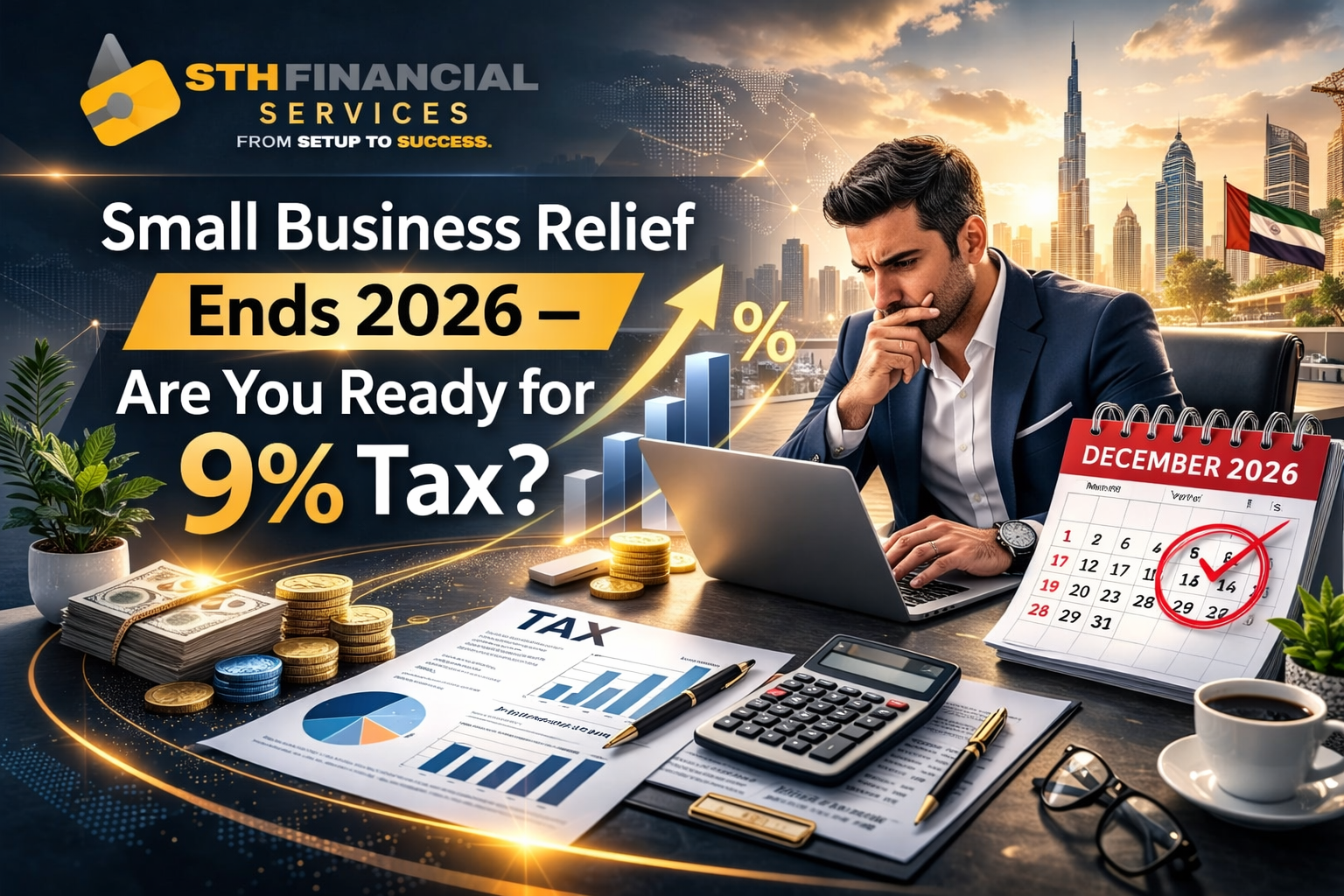
If you’re a small business owner in the UAE relying on Small Business Relief (SBR), there’s an important date on your calendar: December 31, 2026.
That’s when the relief expires. And unless the UAE government extends it (which is currently not announced), thousands of businesses will face their first 9% corporate tax bill starting from 2027.
The question on every SME owner’s mind:
“What happens when Small Business Relief ends, and how do I prepare for 9% corporate tax?”
This isn’t a problem for later—it’s a problem for right now. The decisions you make in 2026 will determine whether your business faces a financial shock or transitions smoothly to the new tax reality.
In this comprehensive guide, we’ll explain exactly what the end of SBR means, what it will cost your business, and the exact steps you need to take today to prepare.
Understanding Small Business Relief: A Quick Refresher
What is Small Business Relief?
Small Business Relief is a temporary measure introduced when UAE Corporate Tax launched in June 2023. It allows qualifying businesses to pay 0% corporate tax on their taxable income.
Current Eligibility (Until December 31, 2026)
| Requirement | Threshold |
|---|---|
| Annual Revenue | AED 3,000,000 or less |
| Tax Rate | 0% on all taxable income |
| Filing Obligation | Still required, but elect “SBR” option |
Key Point: It’s Always Been Temporary
The UAE Ministry of Finance designed SBR as a transitional relief, not a permanent exemption. The law explicitly states it applies only to tax periods ending on or before December 31, 2026.
What Happens After December 31, 2026?
The Hard Truth: 9% Corporate Tax Applies
Once SBR expires, your business will be subject to the standard UAE corporate tax rates:
| Taxable Income | Rate |
|---|---|
| First AED 375,000 | 0% |
| Above AED 375,000 | 9% |
Example: The Real Cost
Let’s say your business has annual taxable income of AED 1,000,000:
With Small Business Relief (2026):
- Corporate Tax: AED 0
Without Small Business Relief (2027+):
- Tax on first AED 375,000: AED 0
- Tax on remaining AED 625,000 at 9%: AED 56,250
- Your new annual tax bill: AED 56,250
That’s money you need to budget for starting in 2027.
Who’s Most Affected?
High-Risk Businesses
1.
- If your revenue exceeds AED 3 million before December 31, 2026, you already lose SBR
- Planning needed now to manage growth trajectory
2.
- Will face significant tax increase
- Need to build reserves starting in 2026
3.
- First time facing real tax liability
- May not have accounting systems in place
4.
- Many haven’t planned for this expense
- Risk of cash flow surprises in 2027
Critical Deadlines You Must Know
| Date | Milestone |
|---|---|
| Now – December 2026 | Prepare finances for post-SBR era |
| Your tax period end 2026 | Last period eligible for SBR |
| Your tax period start 2027 | Standard 9% rate applies |
| 9 months after year end | Corporate tax return due |
Example:
If your financial year ends December 31, 2026:
- Last SBR-eligible return: Due September 2027
- First 9% tax return: Due September 2028
10 Steps to Prepare for the End of Small Business Relief
Step 1: Calculate Your Future Tax Liability Now
Don’t wait until 2027 to discover your new tax bill. Calculate it today:
Formula:
- Take your expected taxable income for 2027
- Subtract AED 375,000 (tax-free threshold)
- Multiply the remainder by 9%
Example:
- Expected profit: AED 800,000
- Minus threshold: AED 800,000 – AED 375,000 = AED 425,000
- Tax at 9%: AED 38,250
Action: Build this into your 2026 budget and cash flow planning.
Step 2: Review Your Accounting Systems
Many SBR-qualifying businesses have minimal accounting setups. Now is the time to upgrade:
Essential Requirements for 2027+:
- Accurate bookkeeping (monthly, not annual)
- Proper cost tracking by category
- Audit-ready financial statements
- Tax calculation capability
- Support for expense categorization
Recommendation: Engage a professional accountant or firm before the end of 2026.
Step 3: Separate Personal and Business Expenses
This is critical. The FTA scrutinizes businesses paying 9% tax more closely than those on SBR.
Common Red Flags:
- Owner using business funds for personal expenses
- No separation between company and personal accounts
- Expenses without proper documentation
Action: Audit your expense claims now. Clean up any issues before the tax rate changes.
Step 4: Maximize Legitimate Deductions Before Year End
While you’re still on SBR, ensure you’re maximizing all available deductions:
Fully Deductible Expenses:
- Employee salaries and benefits
- Office rent and utilities
- Professional fees
- Marketing and advertising
- Business travel
- Depreciation on assets
Partially Deductible (50%):
- Client entertainment
Non-Deductible:
- Fines and penalties
- Personal expenses
- Dividends paid (not expenses)
Pro Tip: Accelerate legitimate expenses into 2026 if possible to reduce taxable income.
Step 5: Plan Your Capital Expenditures
Capital assets (equipment, vehicles, furniture) can’t be expensed immediately—they must be depreciated over time.
If you need new equipment:
- Buy it before year-end to start depreciation
- Ensure assets are properly recorded
- Keep all purchase documentation
Tip for 2026: Review your asset register and ensure all purchases are properly categorized.
Step 6: Consider Timing of Revenue and Expenses
If you have flexibility in when to recognize income or incur expenses, strategic timing can help:
Income Deferral: If possible, delay invoicing major clients to January 2027 if it keeps you under the AED 375,000 threshold.
Expense Acceleration: Bring forward planned expenses to December 2026 where legitimate.
Caution: Don’t manipulate artificially. All timing must have genuine business purpose.
Step 7: Build a Tax Reserve
If you haven’t been saving for corporate tax, start now.
Recommended Reserve Calculation:
- Estimate 2027 taxable income
- Calculate 9% of amount above AED 375,000
- Set aside this amount in a dedicated savings account
Example:
- Expected profit: AED 1,000,000
- Expected tax: AED 56,250
- Monthly savings needed (12 months): AED 4,688/month
Step 8: Evaluate Business Structure
The end of SBR is a good time to review whether your current structure is optimal:
Questions to Ask:
- Should some activities be spun into separate entities?
- Is a Free Zone structure more tax-efficient now?
- Would a mainland company provide better deductions?
Action: Consult with a tax advisor to evaluate structure options.
Step 9: Prepare for Audit Requirements
Businesses on SBR had minimal FTA scrutiny. That changes with 9% tax.
New Requirements:
- Audited financial statements (mandatory above certain thresholds)
- Proper support for all deductions claimed
- Transfer pricing documentation if related party transactions exist
- Detailed records for 7 years minimum
Action: Ensure your records can withstand FTA scrutiny.
Step 10: Engage Professional Help
You don’t have to navigate this alone.
What a Tax Advisor Can Do:
- Calculate your future tax liability
- Identify legitimate tax planning opportunities
- Prepare your accounting systems
- Represent you in FTA communications
- File compliant tax returns
When to Engage: The earlier, the better. Start conversations in mid-2026 at the latest.
What If My Revenue Exceeds AED 3 Million Before December 2026?
If your revenue exceeds AED 3,000,000 in any tax period ending on or before December 31, 2026, you lose SBR eligibility immediately.
Example:
- Your tax year ends March 31, 2026
- Revenue from April 1, 2025 to March 31, 2026 exceeds AED 3 million
- You’re subject to 9% tax for that period
- No SBR available
Action: Monitor your revenue monthly. If approaching the threshold, plan accordingly.
Will the Government Extend Small Business Relief?
Current Status: No extension has been announced.
What We Know:
- The original law explicitly stated December 31, 2026 as the end date
- The Ministry of Finance has not issued any decision to extend
- Businesses should not rely on an extension materializing
Best Approach: Plan as if SBR is ending. If an extension is announced, you’ll be pleasantly surprised.
Summary: Your Action Plan
Immediate Actions (Now):
- Calculate expected 2027 tax liability
- Set up tax reserve fund
- Review accounting systems
By June 2026:
- Engage tax advisor
- Clean up expense records
- Plan capital expenditures
By December 2026:
- Maximize legitimate deductions
- File final SBR-eligible return
- Prepare for 9% rate effective January 2027
Ongoing:
- Maintain proper books monthly
- Monitor revenue against thresholds
- Stay updated on FTA guidance
Common Questions
Q: Can I still claim SBR for the 2026 tax period if my year ends March 31, 2027?
A: No. SBR applies only to tax periods ending on or before December 31, 2026. If your year ends March 31, 2027, standard rates apply from day one.
Q: What if I’m just below AED 3 million revenue—should I stay small to keep SBR?
A: This is a common concern, but artificially limiting growth to avoid tax is rarely smart. The AED 56,250 tax on AED 1 million profit is far less than the opportunity cost of stunted growth. Focus on profitability, not avoiding the threshold.
Q: Do I need to re-register for corporate tax when SBR ends?
A: No. Your existing corporate tax registration continues. You just need to ensure your tax return reflects the standard rate starting from your first post-SBR tax period.
Q: Can I switch from SBR to Free Zone to avoid 9% tax?
A: Potentially, but it’s not automatic. Free Zone companies must qualify as “Qualifying Free Zone Persons” (QFZP) to enjoy 0% on qualifying income. This requires meeting substance and other requirements. The transition also has timing implications. Consult an advisor before making this change.
Q: What happens if I don’t file a return when SBR ends?
A: Penalties apply: AED 500 per month for late filing (first 12 months), escalating to AED 1,000 per month thereafter. Plus interest on any tax due. Don’t skip filing.