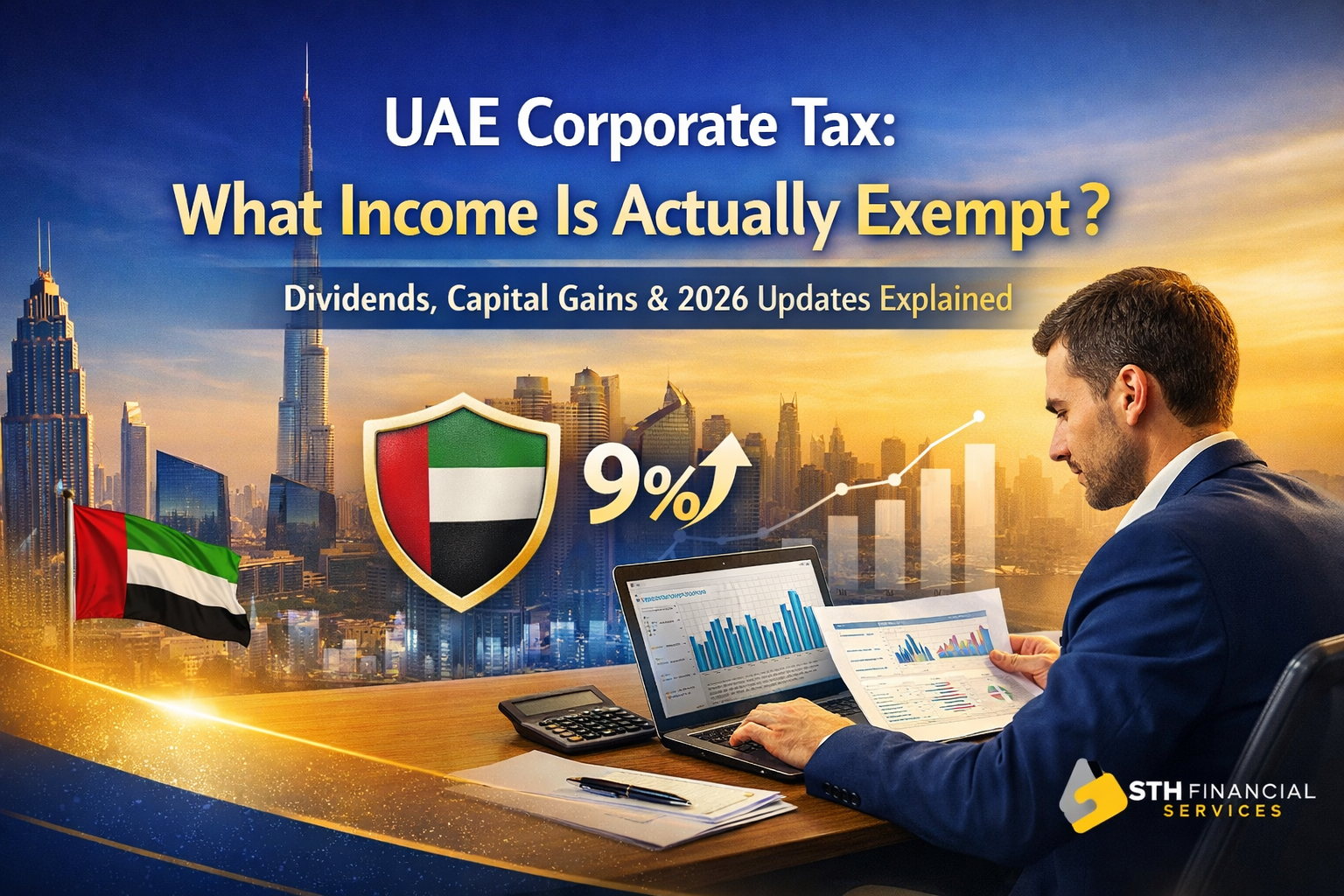
One of the biggest advantages of the UAE’s corporate tax regime is the various exemptions available to businesses. Understanding which incomes are exempt can significantly reduce your tax liability—and in some cases, eliminate it entirely.
The question many UAE business owners ask:
“What income can I exclude from my corporate tax calculation?”
The answer isn’t always straightforward. The UAE Corporate Tax Law specifies several exempt income categories, each with its own eligibility requirements and conditions.
In this comprehensive guide, we’ll walk through every category of exempt income under UAE Corporate Tax—from dividends and capital gains to qualifying investment funds and government entities.
Understanding Exempt Income in the UAE
What Is Exempt Income?
Exempt income refers to specific types of income that are not included in the calculation of taxable income for corporate tax purposes. While this income is not taxed, it’s important to note:
- Exempt income must still be reported in your corporate tax return
- Some exemptions have specific qualification conditions
- Certain exempt income affects the calculation of Small Business Relief thresholds
Categories of Exempt Income Under UAE Corporate Tax
1. Dividends and Profit Distributions
Overview: Dividends received by a UAE taxable person from another UAE taxable person (or from a foreign company) are generally exempt from corporate tax.
Key Conditions:
- The distributing entity must have paid corporate tax on its profits (or be exempt)
- For foreign dividends: Minimum 10% shareholding usually required
- Dividends from exempt entities (like qualifying investment funds) are also exempt
Example:
- Your company owns 30% of a Dubai trading company
- That company declares dividends of AED 500,000
- Your company pays 0% tax on this AED 500,000 dividend income
Important Note: Dividends are included in the AED 3 million revenue calculation for Small Business Relief eligibility—even though they’re exempt from tax.
2. Capital Gains from Exempt Assets
Overview: Certain capital gains are treated as exempt income under specific conditions.
Exempt Capital Gains Include:
| Type of Gain | Condition |
|---|---|
| Gains from qualifying share disposals | Minimum 10% holding, held for at least 12 months |
| Gains from designated excluded territories | Must meet UAE regulatory requirements |
| Reinvestment reliefs | When proceeds reinvest in qualifying assets |
Key Point: Not all capital gains are exempt. Gains from the sale of non-qualifying assets (like real estate in certain cases) are typically taxable.
3. Qualifying Investment Fund (QIF) Income
Recent Update – 2025: Cabinet Decision No. 34 of 2025 significantly updated the QIF regime, making it more attractive for fund managers and investors.
What Is a Qualifying Investment Fund?
A Qualifying Investment Fund is a fund that meets specific conditions set by the UAE Ministry of Finance and is approved by the FTA.
Key Benefits:
- Fund itself is exempt from corporate tax on its income
- Distributions to investors are not taxable in the fund’s hands
- Investors can receive income without additional tax leakage
Qualification Criteria (Simplified):
| Requirement | Description |
|---|---|
| Fund Type | Must be a collective investment scheme |
| Regulatory Status | Must be authorized/registered with relevant UAE authority |
| Investment Restrictions | Must meet portfolio diversification requirements |
| Disclosure | Must provide investor-level data to FTA |
Types of QIFs:
- Mutual funds
- Private equity funds
- Real Estate Investment Trusts (REITs)
- Infrastructure funds
- Venture capital funds
Investor-Level Exemption (New 2025):
Under the updated rules, income received by investors from a QIF may be exempt, provided the investor meets certain conditions. This prevents double taxation at the fund and investor levels.
4. Income of Qualifying Public Benefit Entities
Overview: Entities established for charitable, religious, scientific, or other public benefit purposes may be exempt from corporate tax.
Qualifying Criteria:
- Must be established in the UAE
- Must have no shareholders or owners with economic interest
- Must use income for qualifying public benefit purposes
- Must be registered with relevant UAE authorities
Examples of Qualifying Entities:
- Registered charities
- Religious organizations
- Educational institutions (non-profit)
- Healthcare organizations (non-profit)
- Social welfare entities
Documentation Required: These entities must apply to the FTA for recognition as a Qualifying Public Benefit Entity.
5. Government Entity Income
Overview: Income earned by UAE federal and local government entities is exempt from corporate tax.
Scope of Exemption:
- Federal government ministries and departments
- Emirate-level government departments
- Government-owned enterprises (in certain cases)
- Entities where government is the sole shareholder
Key Point: The exemption applies primarily to entities performing sovereign functions. Commercial government-owned companies may still be subject to corporate tax unless they qualify under another exemption category.
6. Pension and Social Security Funds
Overview: Income of pension funds and social security funds established in the UAE is exempt.
Qualifying Funds:
- UAE federal pension funds
- Emirate-level pension funds
- Private sector pension schemes (registered with relevant authorities)
- Social security funds
Conditions:
- Fund must be established under UAE law
- Must be a separate legal entity
- Must meet regulatory requirements for pension funds
7. International and Sports Entities (2026 Update)
Overview: Cabinet Decision No. 1 of 2026 clarified the exemption for qualifying international organizations and sports entities.
Qualifying Entities:
- International organizations with headquarters in the UAE
- Regional headquarters of multinational corporations (in certain cases)
- Sports organizations meeting specific criteria
- Entities with bilateral agreements with the UAE government
Documentation: These entities must obtain formal recognition from the competent UAE authority.
Exempt Persons vs. Exempt Income: Understanding the Difference
Exempt Persons
Some entities are entirely exempt from corporate tax—not just specific income types:
| Entity Type | Tax Status |
|---|---|
| Qualifying Public Benefit Entities | 100% exempt |
| Government Entities | 100% exempt |
| Pension Funds | 100% exempt |
| Qualifying Investment Funds | 100% exempt |
Exempt Income (for Taxable Persons)
Even if you’re a taxable person, certain income types are excluded from tax calculation:
| Income Type | Exempt? |
|---|---|
| Dividends from qualifying sources | Yes |
| Capital gains on qualifying assets | Yes |
| Income from QIFs | Yes (conditions apply) |
| Foreign branch income (certain cases) | Yes |
How Exempt Income Affects Your Tax Calculation
Step-by-Step Process
Step 1: Start with accounting profit (from audited financial statements)
Step 2: Add back non-deductible expenses
Step 3: Subtract exempt income
Step 4: Apply deductions (e.g., tax losses carried forward)
Step 5: Calculate taxable income
Step 6: Apply corporate tax rates
Example:
| Item | Amount (AED) |
|---|---|
| Accounting Profit | 1,500,000 |
| Add: Non-deductible expenses | 100,000 |
| Subtotal | 1,600,000 |
| Less: Exempt dividend income | (200,000) |
| Taxable Income | 1,400,000 |
Tax Calculation:
- First AED 375,000 at 0% = AED 0
- Remaining AED 1,025,000 at 9% = AED 92,250
Without Exemption:
- Full AED 1,600,000 taxable
- Tax = AED 146,250 – AED 92,250 = AED 54,000 saved
Common Mistakes to Avoid
Mistake 1: Assuming All Dividends Are Exempt
Reality: Only dividends from qualifying sources are exempt. Dividends from non-exempt foreign companies may be taxable.
Solution: Review the source of all dividend income and confirm qualification.
Mistake 2: Ignoring Exempt Income in Record-Keeping
Reality: Even exempt income must be tracked and reported in your corporate tax return.
Solution: Maintain clear records of all exempt income with supporting documentation.
Mistake 3: Not Understanding the Interaction with SBR
Reality: Exempt income (like dividends) is included in the AED 3 million Small Business Relief threshold calculation—even though it’s not taxed.
Solution: Understand that growing exempt income can push you over the SBR threshold.
Mistake 4: Missing QIF Documentation Requirements
Reality: To claim QIF-related exemptions, you need proper documentation from the fund.
Solution: Request confirmation letters from fund managers showing QIF status.
Recent Updates: 2025-2026 Changes
Cabinet Decision No. 34 of 2025 (QIF Updates)
Key Changes:
- Enhanced flexibility for QIF structures
- Improved investor-level exemptions
- Simplified reporting requirements
- Broader definition of qualifying fund activities
Impact: Fund managers and investors should review whether the updated rules create new planning opportunities.
Cabinet Decision No. 1 of 2026 (Sports Entities)
Key Changes:
- Clarified exemption for qualifying international sports organizations
- Specified documentation requirements
- Defined qualifying activities
How to Claim Exempt Income Benefits
Documentation Requirements
| Exempt Income Type | Required Documentation |
|---|---|
| Dividends | Dividend vouchers, shareholding documents, distributing entity’s tax status |
| Capital Gains | Share purchase agreements, holding period evidence |
| QIF Income | QIF confirmation letter from fund manager |
| Government Entity Income | Entity registration, ownership structure |
| Pension Fund Income | Fund registration certificate |
Reporting in Tax Return
When filing your corporate tax return:
Planning Opportunities
For Businesses with Dividend Income
- Consider corporate holding structures to bunch dividends and reduce tax
- Review shareholding percentages to ensure qualifying thresholds are met
- Time dividend receipts to optimize cash flow and tax position
For Investors in Funds
- Confirm QIF status of any fund investments
- Review 2025 changes for potential new exemptions
- Consider fund structure when making new investment decisions
For Charities and Public Benefit Organizations
- Apply for Qualifying Public Benefit Entity status if not yet recognized
- Ensure income is used for qualifying purposes
- Maintain proper records of charitable activities
Checklist: Exempt Income Compliance
Use this checklist to ensure proper handling of exempt income:
- Identify all potential exempt income streams
- Confirm qualification for each exemption category
- Gather required documentation for each type
- Report exempt income correctly in tax return
- Maintain records for minimum 7 years
- Review changes in exemptions (2025-2026 updates)
- Consult tax advisor for complex situations
Common Questions About Exempt Income
Q: Is all dividend income from UAE companies exempt?
A: Generally yes, if the distributing company is a UAE taxable person (or exempt). However, ensure the dividend meets anti-abuse rules if there’s complex structuring.
Q: What happens if I receive dividends from a foreign company?
A: Foreign dividends may be exempt if you hold at least 10% of the foreign company’s shares. Additional conditions apply—consult a tax advisor.
Q: Can a taxable company earn exempt income and still pay 9% tax on other income?
A: Yes. Exempt income is simply excluded from taxable income calculation. Your other income remains taxable at 9% on amounts above AED 375,000.
Q: Do I need to register as a Qualifying Investment Fund to benefit?
A: The fund must be a QIF—you can’t simply claim the exemption yourself. The fund manager should confirm QIF status.
Q: Does exempt income affect my ability to claim Small Business Relief?
A: Yes. Exempt income is included in the AED 3 million revenue threshold calculation for SBR, even though it’s not taxed.
Conclusion
The UAE Corporate Tax regime offers meaningful exemptions that can significantly reduce your tax burden. However, navigating these rules requires careful attention to:
- Qualification requirements for each exempt category
- Proper documentation to support exemption claims
- Correct reporting in your tax returns
- Staying updated on regulatory changes (like the 2025 QIF updates)
Don’t assume income is exempt without verifying the specific conditions. A qualified tax advisor can help you identify all available exemptions and ensure proper compliance.
Need Help Maximizing Your Corporate Tax Exemptions?
At STH Financial, our corporate tax specialists help UAE businesses:
✓ Identify all available exempt income categories
✓ Ensure proper documentation for exemption claims
✓ Navigate QIF and fund-related exemptions
✓ Optimize tax position within legal limits
✓ Stay compliant with FTA requirements
📞 Contact us for a comprehensive tax exemption review.