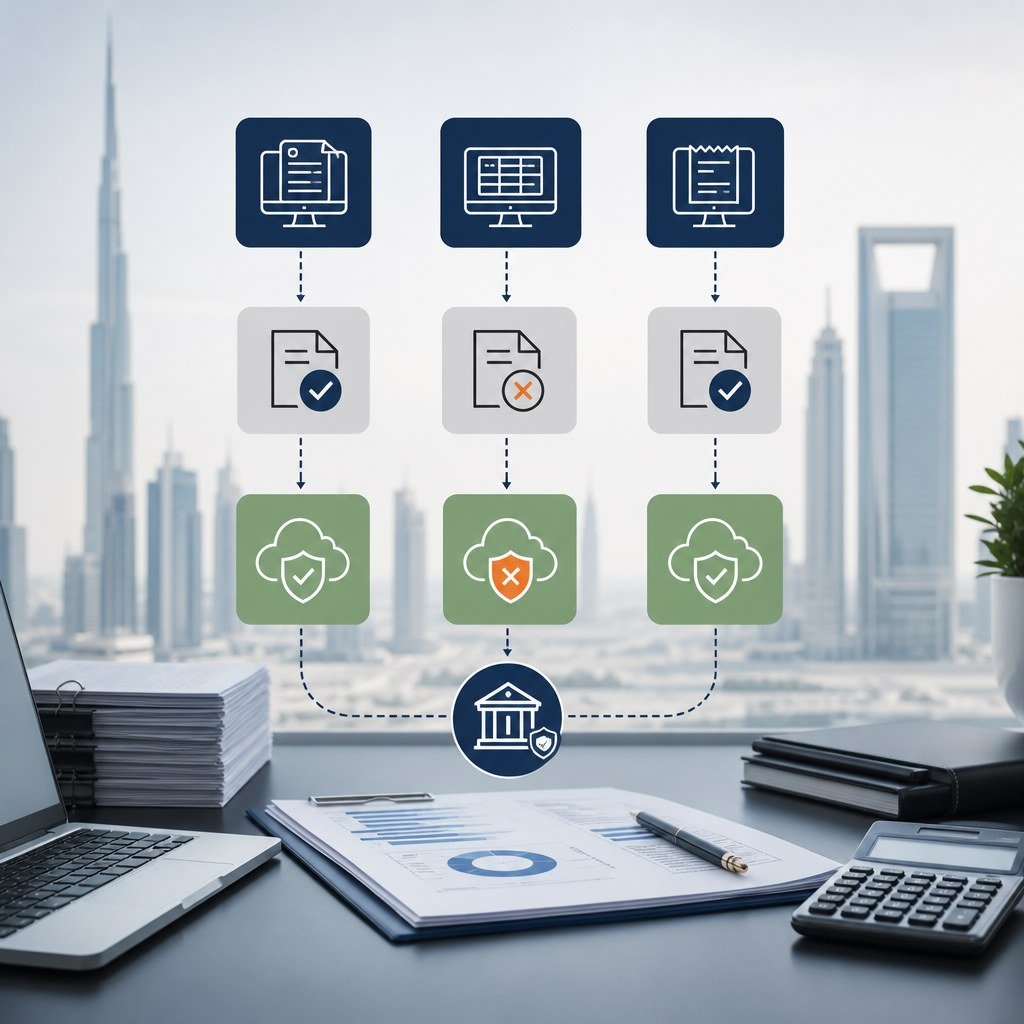
Zoho Books, QuickBooks and Xero can help you prepare cleaner VAT invoices and structured accounting data, but they do not remove the need for a UAE Accredited Service Provider where the mandate requires regulated exchange, validation and reporting. Your decision should focus on which system gives you the best data, workflow and integration base for e-invoicing in the UAE, not on which one can “do everything” alone.
Assumption for this article: you are using the standard cloud versions of Zoho Books, QuickBooks Online or Xero available to a UAE business, without a separately contracted Accredited Service Provider, certified connector or bespoke integration layer. If your software vendor later becomes accredited or bundles an accredited partner, you should verify the scope in writing before relying on it.
01 What your accounting software can realistically handle
Your accounting platform remains important because e-invoicing starts with source data. If your customer names, TRNs, VAT treatment, invoice dates, credit notes and line descriptions are inconsistent, an Accredited Service Provider cannot make your process compliant without corrections.
Zoho Books, QuickBooks and Xero can usually support day-to-day accounting tasks such as issuing invoices, recording VAT, managing contacts, producing reports and exporting information. Depending on your configuration, they may also provide APIs, import tools or app connections that allow invoice data to move into another system.
What they cannot be assumed to do on their own is act as the UAE-mandated exchange and reporting layer. The official UAE model is not simply “send a PDF by email.” It is based on structured electronic invoice data, system-to-system exchange and participation by approved service providers.
Note: Ministry of Finance and Federal Tax Authority public e-invoicing programme materials reviewed on 25 October 2026 describe a structured e-invoicing framework involving Accredited Service Providers. Check the latest official MoF and FTA publications before signing a software contract.
02 Platform-by-platform comparison
The practical question is not whether the platform can produce an invoice. All 3 can. The question is whether the platform can produce the right data, connect reliably to your compliance architecture and support your VAT controls.
If you already use one of these platforms successfully, you may not need to replace it. You may need to strengthen master data, map fields and connect it to the right Accredited Service Provider when your phase applies.
03 How to judge Zoho Books, QuickBooks and Xero for readiness
Use the same test for all 3 platforms. A good accounting system for UAE e-invoicing readiness should reduce manual correction, support consistent VAT treatment and allow controlled data movement into the accredited channel.
Data completeness
Check customer TRNs, legal names, addresses, VAT categories, item descriptions and credit note references. Poor data creates compliance friction regardless of software.
Integration options
Ask whether the platform supports APIs, secure exports, field mapping and audit logs. Your ASP or integrator will need dependable invoice data access.
Operational control
Review approval workflows, user permissions, edit restrictions and document numbering. E-invoicing weakens if staff can bypass the agreed process.
When Zoho Books may be the better fit
Zoho Books may suit you if your business already uses Zoho apps and you want a connected finance, CRM and operations environment. It is often attractive where you need workflow configuration, recurring invoices and app-to-app data movement.
When QuickBooks may be the better fit
QuickBooks may suit you if you want familiar SME accounting, simple invoicing and a finance process managed closely by your accountant or bookkeeper. Before choosing it, confirm UAE VAT configuration, data export quality and integration support for your expected volume.
When Xero may be the better fit
Xero may suit you if you value its reporting style, bank reconciliation workflow and app ecosystem. It can work well where your sales process happens outside the accounting system and invoice data needs to be pulled together from multiple tools.
04 Practical readiness checklist before you choose
Run this checklist before renewing software, migrating data or signing with an Accredited Service Provider.
- Confirm your invoice flows. List B2B, B2C, export, advance payment, credit note and intercompany scenarios.
- Clean your master data. Standardise customer names, TRNs, addresses, tax codes and product or service descriptions.
- Map mandatory fields. Compare your current invoice fields with the latest UAE e-invoicing requirements published by MoF and FTA.
- Test sample transactions. Use realistic invoices, tax invoices, credit notes and corrections instead of only simple sales invoices.
- Ask vendors direct questions. Ask whether the product is accredited, connected to an accredited provider, or only “ready” for future integration.
- Document responsibilities. Decide who fixes rejected invoices, monitors errors, reconciles VAT and manages customer onboarding.
- Review your timeline. Check STH Financial’s UAE e-invoicing timeline article before setting internal deadlines, because phase dates and scope can affect your project plan.
Important: “API available” is not the same as “compliant.” An API only moves data. Compliance depends on the required format, validation, exchange, reporting, controls and the status of the service provider.
05 Common mistakes and how to recover
Mistake 1: Treating PDF invoices as e-invoices
A PDF may be a readable copy, but UAE e-invoicing is about structured data and controlled exchange. To recover, identify where invoice data is created, what format it can be exported in and how it will pass through the accredited route.
Mistake 2: Waiting for your software vendor to solve everything
Your vendor may release new features, but your business still owns data quality, VAT treatment, internal controls and implementation timing. To recover, create a readiness file now with your invoice scenarios, fields, gaps and responsible staff.
Mistake 3: Selecting an ASP before mapping your processes
If you choose a provider before understanding your sales flows, you may pay for rework or accept an awkward workflow. To recover, document your current process from quotation to payment, including cancellations and credit notes.
Mistake 4: Ignoring VAT reconciliation
E-invoicing does not replace VAT review. You still need to reconcile taxable supplies, zero-rated supplies, exempt treatment, reverse charge items where relevant and credit notes. To recover, align your VAT return process with invoice status reporting and exception handling.
06 Decision framework for UAE businesses
Choose your accounting software based on business fit, then test whether it can feed the compliant e-invoicing architecture. Use this short framework:
- If you are already stable on Zoho Books, QuickBooks or Xero: do not migrate only because of e-invoicing. First check data quality and integration options.
- If you are choosing new software: prioritise clean VAT setup, strong controls, reliable exports and proven integration support.
- If your invoice volume is high: test automation, error handling and exception dashboards before rollout.
- If your business has complex VAT treatment: involve your tax adviser before field mapping, not after go-live.
- If a vendor claims full compliance: ask for the accredited entity name, scope, contract wording and implementation responsibilities.
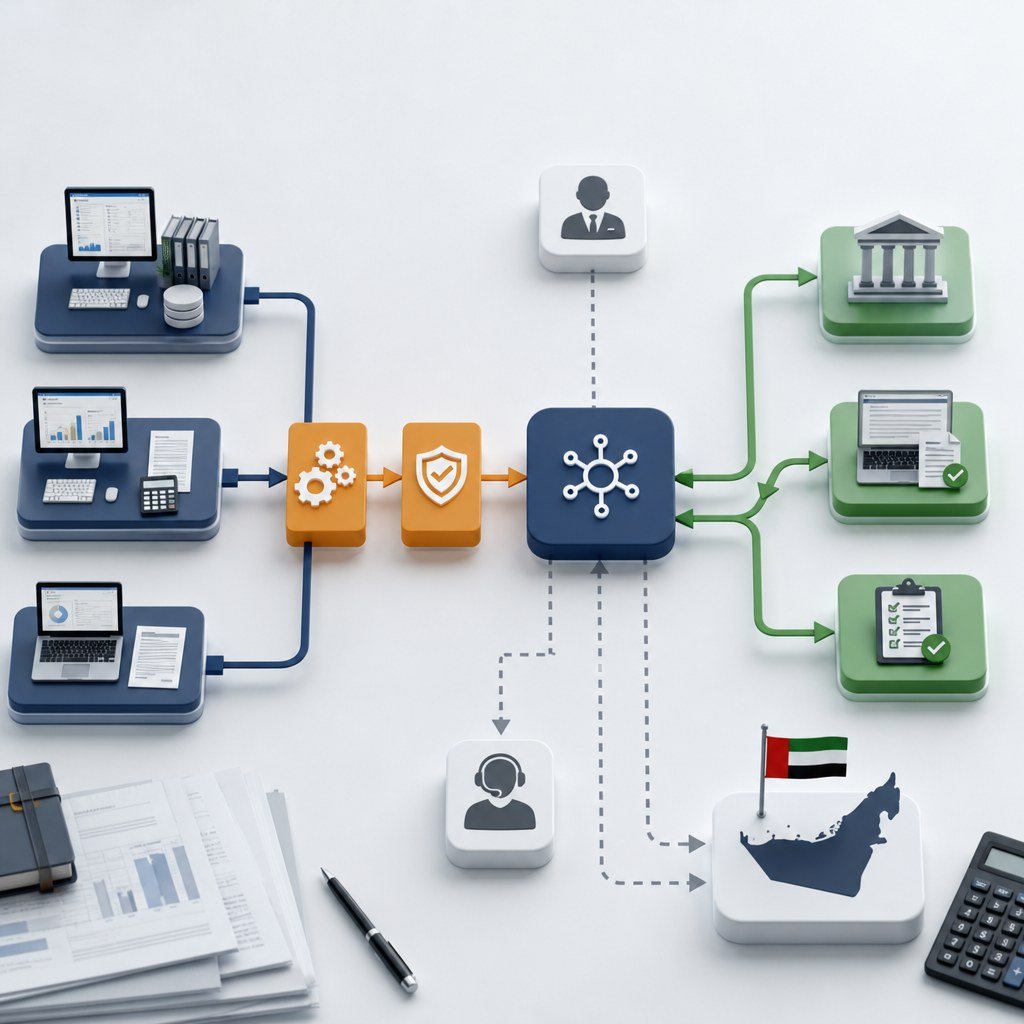
The safest approach is to separate 3 roles: your accounting system records and controls transactions, your Accredited Service Provider handles the regulated exchange and reporting layer, and your finance team owns VAT accuracy and reconciliation.
Next step: assess your current setup before you commit
Prepare a sample pack of invoices, credit notes, VAT codes, customer records and system exports. Then compare what your software produces with the latest official requirements and your expected ASP integration route.
For a broader implementation overview, use STH Financial’s hub on e-invoicing in the UAE and align your software decision with your compliance timeline, VAT controls and operational capacity.